Help My Students Can't Read What Curriculum Would Be Best Second Grsde
Jack Silva didn't know anything nigh how children larn to read. What he did know is that a lot of students in his district were struggling.
Silva is the primary academic officer for Bethlehem, Pa., public schools. In 2015, only 56 percent of 3rd-graders were scoring good on the state reading test. That year, he set out to practise something near that.
"It was really looking yourself in the mirror and saying, 'Which four in 10 students don't deserve to learn to read?' " he recalls.
Bethlehem is not an outlier. Across the country, millions of kids are struggling. According to the National Assessment of Educational Progress, 32 percent of quaternary-graders and 24 percent of eighth-graders aren't reading at a basic level. Fewer than 40 percent are practiced or advanced.
One excuse that educators accept long offered to explicate poor reading performance is poverty. In Bethlehem, a minor city in Eastern Pennsylvania that was once a booming steel town, there are plenty of poor families. But at that place are fancy homes in Bethlehem, besides, and when Silva examined the reading scores he saw that many students at the wealthier schools weren't reading very well either.
Silva didn't know what to practice. To begin with, he didn't know how students in his district were being taught to read. So, he assigned his new director of literacy, Kim Harper, to find out.
The theory is wrong
Harper attended a professional-development twenty-four hour period at one of the commune's lowest-performing uncomplicated schools. The teachers were talking about how students should attack words in a story. When a child came to a give-and-take she didn't know, the teacher would tell her to look at the picture and estimate.
The virtually of import thing was for the child to understand the meaning of the story, not the exact words on the page. So, if a kid came to the give-and-take "horse" and said "firm," the teacher would say, that'due south wrong. But, Harper recalls, "if the kid said 'pony,' it'd be correct because pony and horse mean the same thing."
Harper was shocked. Offset of all, pony and horse don't mean the aforementioned matter. And what does a child do when there aren't whatsoever pictures?
This communication to a offset reader is based on an influential theory about reading that basically says people use things like context and visual clues to read words. The theory assumes learning to read is a natural procedure and that with enough exposure to text, kids will figure out how words piece of work.
However scientists from around the world take done thousands of studies on how people learn to read and take concluded that theory is wrong.
One big takeaway from all that research is that reading is not natural; we are not wired to read from birth. People become skilled readers past learning that written text is a code for oral communication sounds. The primary job for a beginning reader is to crack the lawmaking. Fifty-fifty skilled readers rely on decoding.
So when a child comes to a word she doesn't know, her instructor should tell her to look at all the letters in the word and decode it, based on what that child has been taught about how messages and combinations of letters represent voice communication sounds. There should be no guessing, no "getting the gist of it."
And yet, "this sick-conceived contextual guessing approach to word recognition is enshrined in materials and handbooks used by teachers," wrote Louisa Moats, a prominent reading adept, in a 2017 commodity.
The contextual guessing approach is what a lot of teachers in Bethlehem had learned in their instructor preparation programs. What they hadn't learned is the science that shows how kids actually learn to read.
"Nosotros never looked at brain research," said Jodi Frankelli, Bethlehem's supervisor of early learning. "Nosotros had never, always looked at it. Never."
The educators needed education.
Learning the science of reading
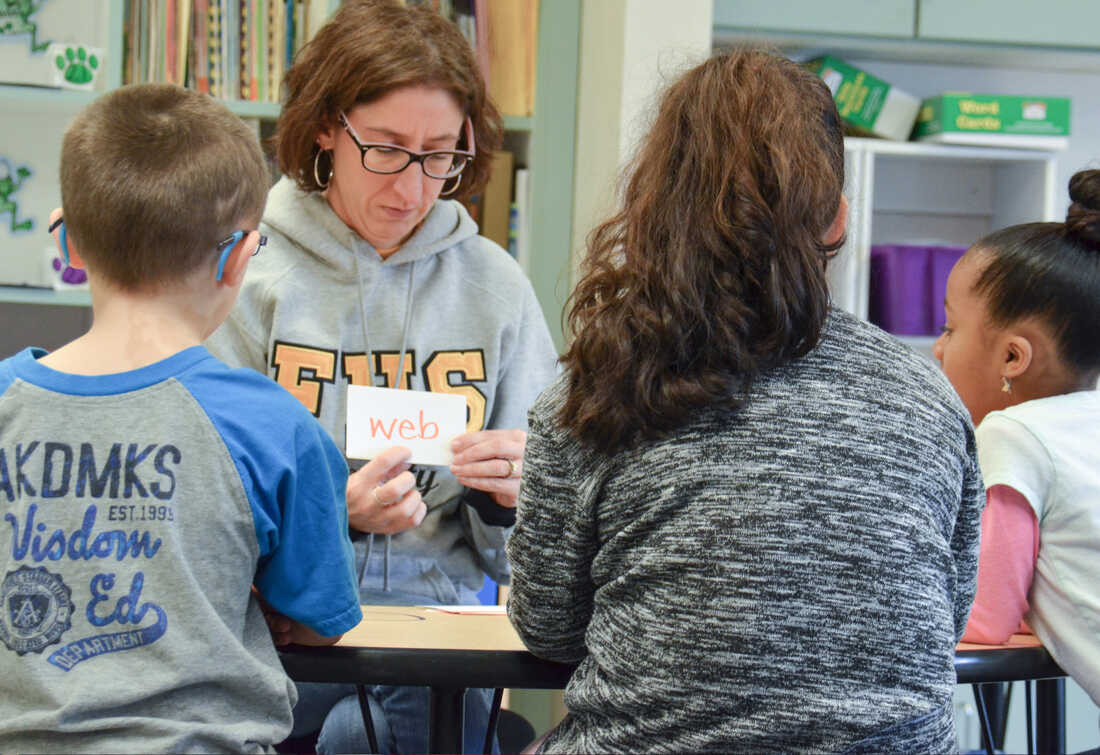
Traci Millheim tries out a new lesson with her kindergarten class at Lincoln Uncomplicated in Bethlehem, Pa. Emily Hanford/APM Reports hide caption
toggle caption
Emily Hanford/APM Reports
On a wintry day in early March 2018, a grouping of mostly first- and second-class teachers was sitting in rows in a conference room at the Bethlehem school district headquarters. Mary Doe Donecker, an educational consultant from an organization called Step-by-Step Learning, stood at the front of the room, calling out words:
"Tell me the start audio you hear in 'Eunice'?"
"Youuu ... " the teachers responded.
Nope. "/Y/, /y/, before you lot get to the /oo/," Donecker explained. "How about "Charlotte?"
This was a class on the science of reading. The Bethlehem commune has invested approximately $iii one thousand thousand since 2015 on training, materials and support to help its early uncomplicated teachers and principals learn the science of how reading works and how children should be taught.
In the class, teachers spent a lot of time going over the sound structure of the English language.
Since the starting point for reading is audio, it's critical for teachers to have a deep understanding of this. But enquiry shows they don't. Michelle Bosak, who teaches English as a 2d linguistic communication in Bethlehem, said that when she was in higher learning to exist a teacher, she was taught nigh nothing about how kids learn to read.
"It was very broad classes, vague classes and similar a children'south literature class," she said. "I did not feel prepared to teach children how to read."
Bosak was among the first grouping of teachers in Bethlehem to attend the new, scientific discipline-based classes, which were presented as a series over the class of a year. For many teachers, the classes were as much about unlearning former ideas about reading — like that contextual-guessing thought — as they were about learning new things.
First-form instructor Candy Maldonado thought she was instruction her students what they needed to know nearly messages and sounds.
"We did a letter of the alphabet a calendar week," she remembers. "And then, if the letter was 'A,' we read books about 'A,' we ate things with 'A,' nosotros found things with 'A.' "
Only that was pretty much information technology. She didn't remember getting into the details of how words are made upwards of sounds, and how letters correspond those sounds, mattered that much.
The main goal was to expose kids to lots of text and get them excited virtually reading. She had no idea how kids acquire to read. Information technology was just that — somehow — they do: "Almost like it'south automated."
Maldonado had been a teacher for more than a decade. Her first reaction afterwards learning about the reading science was shock: Why wasn't I taught this? And so guilt: What well-nigh all the kids I've been teaching all these years?
Bethlehem school leaders adopted a motto to aid with those feelings: "When nosotros know meliorate, we do better."
"My kids are successful, and happy, and believe in themselves"

Cristina Scholl, outset-grade instructor at Lincoln Elementary, uses a curriculum that mixes instructor-directed whole-class phonics lessons with small-group activities. Emily Hanford/APM Reports hibernate caption
toggle caption
Emily Hanford/APM Reports

Cristina Scholl, start-grade teacher at Lincoln Unproblematic, uses a curriculum that mixes teacher-directed whole-class phonics lessons with small-scale-group activities.
Emily Hanford/APM Reports
In a kindergarten class at Bethlehem's Calypso Elementary Schoolhouse in March 2018, veteran teacher Lyn Venable gathered a group of six students at a small, U-shaped table.
"We're going to start doing something today that nosotros have non done earlier," she told the children. "This is brand spanking new."
The children were writing a study about a pet they wanted. They had to write down three things that pet could practise.
A little boy named Quinn spelled the word "bark" incorrectly. He wrote "boc." Spelling errors are like a window into what's going on in a child's brain when he is learning to read. Venable prompted him to sound out the entire word.
"What's the starting time sound?" Venable asked him.
"Buh," said Quinn.
"We got that one. That's 'b.' Now what'southward the next sound?"
Quinn knew the pregnant of "bark." What he needed to figure out was how each audio in the word is represented by letters.
Venable, who has been instruction elementary school for more than two decades, says she used to think reading would just kind of "fall together" for kids if they were exposed to enough print. Now, considering of the scientific discipline of reading grooming, she knows amend.
"My kids are successful, and happy, and believe in themselves," she said. "I don't take a unmarried child in my room that has that await on their face up like, 'I can't practice this.' "
At the end of each school yr, the Bethlehem school district gives kindergartners a test to assess early reading skills.
In 2015, before the new training began, more than half of the kindergartners in the commune tested beneath the criterion score, meaning most of them were heading into first grade at take chances of reading failure. At the end of the 2018 schoolhouse year, later on the science-based grooming, 84 percent of kindergartners met or exceeded the benchmark score. At three schools, information technology was 100 percent.
Silva says he is thrilled with the results, but cautious. He is eager to see how the kindergartners practise when they get to the state reading test in third course.
"We may have striking a dwelling house run in the beginning inning. But at that place'south a lot of game left here," he says.
Emily Hanford is a senior correspondent for APM Reports, the documentary and investigative reporting group at American Public Media. She is the producer of the sound documentary Hard Words, from which this story is adapted.
Source: https://www.npr.org/2019/01/02/677722959/why-millions-of-kids-cant-read-and-what-better-teaching-can-do-about-it
0 Response to "Help My Students Can't Read What Curriculum Would Be Best Second Grsde"
Post a Comment